Implementing Standardized Radiographic Testing for Porosity Detection in Heavy-Duty Additive Manufactured Titanium Industrial Components
Key Takeaways
- Radiographic Testing (RT) is the mandatory non-destructive standard for validating the structural integrity of titanium components produced via Laser Powder Bed Fusion (L-PBF) to prevent fatigue failure.
- Procurement officers must mandate adherence to ASTM E1742 and ISO 15708 to ensure consistent porosity detection benchmarks across the global supply chain.
- Total Cost of Ownership (TCO) models must include the cost of NDT (Non-Destructive Testing) validation and third-party inspection audits to prevent upstream quality failures.
- Supplier selection should prioritize vendors with integrated X-ray CT capabilities to minimize logistics costs and transit risks associated with external testing houses.
Introduction to AM Titanium Procurement
For enterprise-scale manufacturers, the integration of additive manufacturing (AM) for heavy-duty titanium components offers unparalleled design freedom and supply chain agility. However, the stochastic nature of porosity formation in AM—ranging from gas entrapped during atomization to lack-of-fusion voids—poses a significant reliability risk. Procurement managers must pivot from traditional CNC machining procurement models to performance-based validation models that treat Radiographic Testing (RT) not as an add-on service, but as a core requirement within the Service Level Agreement (SLA).
When sourcing titanium-6Al-4V or Ti-6Al-4V ELI parts, the failure to verify internal pore density against strict CAD-to-part tolerances can lead to catastrophic mechanical failure. As a supply chain leader, your responsibility is to codify these technical requirements within your Request for Quotation (RFQ) to ensure that the supplier’s OEE (Overall Equipment Effectiveness) is matched by their internal quality assurance maturity.
The Technical Imperative for Standardized RT
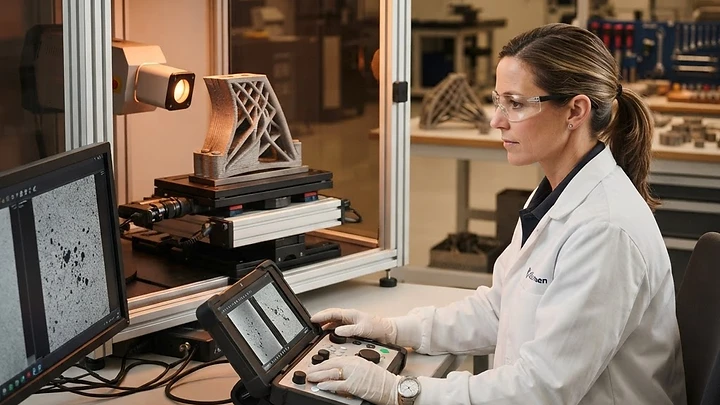
Radiographic Testing, particularly Digital Radiography (DR) and Computed Tomography (CT), is the gold standard for inspecting internal porosity. In titanium AM, porosity is a function of laser energy density, scan strategy, and powder layer thickness. Standardizing your RT protocols across your supply base prevents "quality drift" when scaling production or dual-sourcing across geographic regions.
Critical Compliance Frameworks
To ensure your supplier base meets industrial standards, your RFQ must stipulate the following certifications:
- ASTM E1742: The Standard Practice for Radiographic Examination, providing the baseline for safety and documentation.
- ISO 15708: Non-destructive testing – Radiation methods for computed tomography, essential for complex, internal-channel geometries.
- ASTM F2924/F3001: Standard specifications for AM titanium that dictate acceptable defect limits.
Comparison: Radiographic Methodologies for Procurement
| Feature | 2D Digital Radiography (DR) | Computed Tomography (CT) | Industrial Application |
|---|---|---|---|
| Data Dimensionality | 2D projection | 3D volumetric analysis | Best for thin-walled parts |
| Porosity Detection | High for large voids | High for sub-micron pores | Complex lattice structures |
| Throughput Rate | High (Lower Cost) | Low (Higher Cost) | Screening vs. Deep Audit |
| Inspection Scope | Macro-defects | Micro-voids and cracks | Structural reliability |
Developing a Supplier Quality Scorecard
When evaluating potential partners, use a weighted scoring model. Do not rely solely on unit price (FOB/DDP). The following criteria should dictate your selection process on platforms like Granulon:
- Certification Maturity (30%): Does the supplier hold NADCAP certification for NDT? Are their Level III technicians certified to ASNT standards?
- Process Transparency (25%): Do they provide digital DICOM files for every batch? Is their data management system integrated with your ERP?
- Equipment Capability (25%): What is the power of their X-ray source (e.g., 225kV vs 450kV)? Does it align with the wall thickness of your titanium components?
- Lead Time/Logistics (20%): Can they perform testing in-house, or are they outsourcing, which increases the risk of transit damage or shipment delays?
Implementing a Robust Risk Mitigation Strategy
Cross-border sourcing of critical titanium parts involves significant logistics risk. Implementing the following framework protects your bottom line:
- Define the Inspection Protocol in the RFQ: Specify that the cost of RT must be itemized. Do not accept lump-sum pricing, as it masks potential corners cut in quality control.
- Mandatory First Article Inspection (FAI): Require a full CT scan of the first batch. Use this as a golden master for future production runs.
- Granulon Verification: Utilize the Granulon marketplace to source suppliers who have already been audited for ISO 9001 and AS9100, significantly reducing your internal procurement overhead.
- Incoterms Strategy: Use DAP (Delivered at Place) or DDP (Delivered Duty Paid) to force the supplier to manage the physical integrity of the part during transit, incentivizing them to use better protective packaging against vibrational micro-cracking.
Total Cost of Ownership (TCO) Considerations
Procurement managers often fall into the trap of focusing on piece price. In additive titanium, the TCO is heavily influenced by the scrap rate. If you source a low-cost part without RT validation, the cost of a failed component in a high-stress application exceeds the cost of a thousand verified parts.
- Cost of Failure: Include the liability of recall, maintenance downtime, and replacement parts in your TCO calculation.
- RT Validation Surcharge: A 5-8% increase in unit cost for rigorous, audited RT is an insurance policy against catastrophic operational failure.
Conclusion
Standardizing radiographic testing for titanium additive manufacturing is a strategic imperative. By mandating adherence to international ASTM and ISO standards, leveraging platforms like Granulon to connect with verified, high-maturity suppliers, and employing a rigorous, data-driven supplier scorecard, you can mitigate the inherent risks of AM while reaping the benefits of advanced industrial manufacturing. Focus your procurement strategy on verifiable quality data to ensure that your supply chain is as resilient as the components you procure.