Developing Standardized Vibration Analysis Protocols for Bulk Motor Bearing Procurement
Key Takeaways
- Implement standardized vibration analysis based on ISO 10816 and ISO 20816 to establish objective acceptance criteria for new motor bearings prior to warehouse intake.
- Reduce Total Cost of Ownership (TCO) by identifying pre-existing bearing defects—such as race pitting or lubrication inconsistencies—before they enter the production environment and impact OEE.
- Utilize a weighted vendor evaluation scorecard that integrates technical performance data, INCOTERMS compliance, and third-party audit verification to ensure supply chain resiliency.
- Mitigate cross-border sourcing risks by mandating batch-specific vibration spectrum analysis reports (FFT) as a condition in the RFQ process and vendor SLA.
The Strategic Importance of Pre-Procurement Validation
For enterprise manufacturers, the hidden costs of procuring sub-standard motor bearings extend far beyond the initial purchase price. When bulk shipments arrive, they are often processed into inventory without empirical verification. However, the installation of a defective bearing results in immediate degradation of Overall Equipment Effectiveness (OEE) and potential catastrophic failure of high-value capital assets.
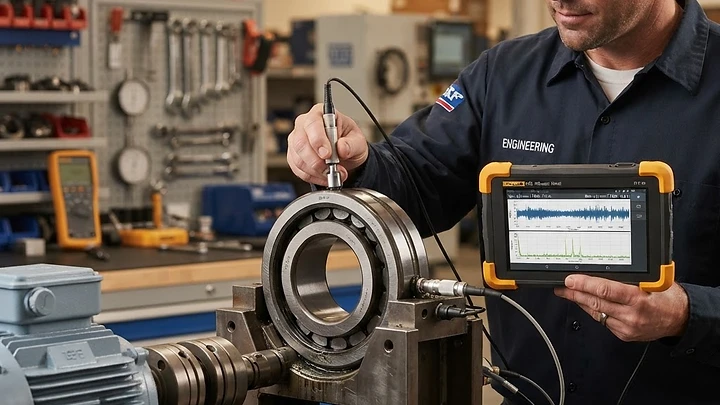
Standardizing vibration analysis protocols at the point of procurement intake acts as a critical quality gate. By shifting the verification process left—before the component is mounted—procurement managers can effectively enforce vendor accountability. This proactive approach transforms the intake process from a simple receiving task into a rigorous quality assurance checkpoint, ensuring that the components meeting your facility floor adhere to the strict tolerances required for modern industrial machinery.
Establishing the Technical Baseline: ISO Standards and Beyond
Reliable vibration analysis requires adherence to internationally recognized benchmarks. Relying on subjective quality checks is a significant risk factor in cross-border procurement. Procurement officers should mandate that all bulk suppliers provide technical documentation aligning with the following standards:
- ISO 10816 / ISO 20816: These standards provide the basis for evaluating machine vibration by measurements on non-rotating parts. While primarily for machine monitoring, the principles of spectral analysis—specifically identifying peak amplitudes at the Bearing Pass Frequencies (BPF)—are critical for testing new bearings.
- ASTM International Standards: Various ASTM standards govern the testing of lubricants and metallic materials used in bearings, which directly influence vibration characteristics.
- Bearing Tolerance Classes (ABEC/ISO): Ensure the bearing grade specified in the RFQ matches the vibration signature. A deviation often indicates non-conformance in manufacturing or heat treatment processes.
Comparing Testing Methodologies
| Feature | Subjective Manual Check | Accelerated Life Testing | Spectral Vibration Analysis |
|---|---|---|---|
| Objective Accuracy | Low | High | Very High |
| Cost per Unit | Minimal | High | Moderate |
| Detects Micro-pitting | No | Yes | Yes |
| Scalability for Bulk | High | Low | Medium (Sampling Required) |
The Vendor Evaluation Framework
When sourcing via marketplaces like Granulon, procurement managers must evaluate suppliers beyond price alone. A robust vendor evaluation framework should utilize a weighted scoring system that prioritizes technical validation capabilities.
Weighted Scoring Criteria (Total: 100 Points)
- Technical Performance Documentation (30 Points): Suppliers must submit FFT (Fast Fourier Transform) reports for batch samples.
- Regulatory Compliance & RoHS/REACH (20 Points): Essential for cross-border logistics to prevent customs delays.
- Audit History & Quality Certifications (20 Points): Verified ISO 9001:2015 and IATF 16949 statuses.
- Logistics & INCOTERMS Versatility (15 Points): Capability to manage complex shipping requirements (DDP vs. CIF).
- Service Level Agreements (SLA) Adherence (15 Points): Clear terms for defect rectification and financial liability.
Practical Intake Checklist for Procurement Teams
To ensure consistency across the supply chain, the following protocol should be integrated into your incoming goods inspection (IGI) procedures:
- Randomized Sampling: Apply MIL-STD-105E sampling plans to determine the number of bearings tested per batch based on order volume.
- Environmental Conditioning: Ensure bearings are acclimated to the testing environment temperature for at least 4 hours to prevent thermal influence on grease viscosity, which can skew vibration readings.
- Cleanliness Protocol: Conduct analysis in a dust-controlled environment to prevent false positives from debris.
- FFT Spectrum Comparison: Compare the spectrum of the new bearing against the 'Golden Sample' baseline provided by the OEM or design specifications.
- Automated Data Logging: Integrate vibration data directly into your ERP/CMMS system to maintain an audit trail for supplier performance reviews.
Managing Cross-Border Risks and Logistics
Cross-border procurement presents unique risks, particularly regarding quality non-conformance. When purchasing from international suppliers, the cost of returning defective batches—often under EXW or FOB terms—can erode any price advantages gained by bulk purchasing.
Strategic Mitigation Tactics
- Escrow and Milestone Payments: Link the final release of funds to the successful validation of the vibration analysis report upon arrival. Platforms like Granulon facilitate this secure exchange, ensuring that verified suppliers remain motivated to provide high-quality components.
- Contractual Quality Buffers: Explicitly define the rejection threshold in the master service agreement. Specify that vibration amplitudes exceeding 10% of the nominal range constitute an automatic breach of contract.
- Third-Party Inspection Mandates: For high-volume or high-value orders, engage third-party quality auditors at the source, prior to shipment. This ensures that only validated units are packaged for transit, saving significant shipping and custom-clearing costs.
Driving Efficiency through Data-Driven Sourcing
In modern B2B manufacturing, procurement is no longer a transactional role; it is a strategic function that directly influences plant reliability. By developing standardized vibration analysis protocols, you insulate your operations from the 'hidden failure' cycle.
Integrating these protocols into your intake procedure not only improves OEE but also provides the data necessary to refine your supplier list. Suppliers who cannot provide consistent, vibration-validated bearings are a liability. By utilizing data to hold suppliers accountable, you transition from reactive purchasing to proactive supply chain management.
Granulon serves as the essential bridge in this transition, connecting your team with verified global suppliers who are prepared to meet your technical requirements. As you scale, the ability to replicate this quality gate across different procurement channels will be the deciding factor in your long-term success, reducing maintenance overheads and ensuring the longevity of your high-performance rotating equipment.