Designing Automated Cross-Docking Workflows to Reduce Demurrage Fees for Bulk Hazardous Chemical Shipping Containers
Key Takeaways
- Automated cross-docking reduces demurrage costs by minimizing terminal dwell time through pre-verified documentation and synchronized cargo arrivals.
- Total Cost of Ownership (TCO) for hazardous material shipping must integrate compliance penalties, detention fees, and buffer stock holding costs.
- Standardized API-driven communication between terminal operators and chemical manufacturers eliminates manual entry errors that trigger regulatory holds.
- Utilizing a centralized procurement platform like Granulon allows manufacturers to source verified suppliers who adhere to rigid ISO and REACH compliance standards.
The Strategic Imperative of Cross-Docking in Hazardous Chemical Logistics
For enterprise-scale manufacturers, the procurement of hazardous chemicals involves a complex dance of regulatory compliance and logistical precision. When moving bulk containers—ISO tanks, flexitanks, or intermediate bulk containers (IBCs)—the margin for error is razor-thin. Demurrage and detention fees are not merely administrative nuisances; they represent significant leakage in your supply chain budget. These costs are often the result of poor synchronization between inbound and outbound freight, exacerbated by the stringent regulatory environment governing hazardous goods.
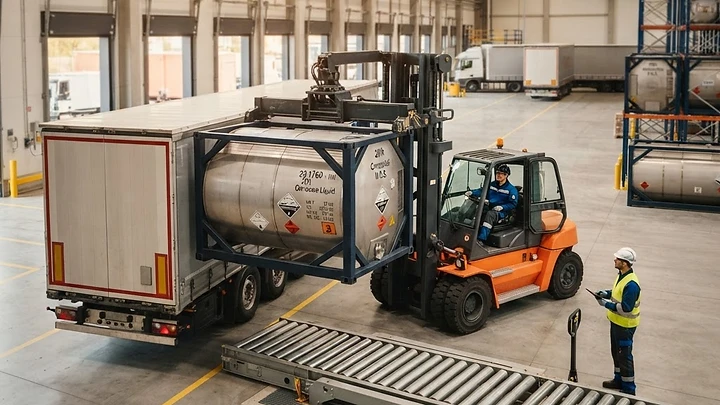
Automated cross-docking is the transition from a storage-centric model to a flow-centric model. By moving goods directly from an incoming carrier to an outbound vehicle with minimal to no storage duration, manufacturers can avoid the heavy surcharges levied by terminals for exceeding 'free time.' For hazardous materials, this is doubly critical, as the risk profile—and therefore the insurance and storage costs—increases significantly for every hour a container sits in a port or intermodal yard.
Leveraging Automation for Regulatory Compliance and Speed
Manual processes are the primary culprit in supply chain friction. In hazardous chemical shipping, missing a single document—such as a Safety Data Sheet (SDS) or a specialized Bill of Lading (BoL) compliant with the IMDG Code—can lead to a 'stop order' from port authorities. Automation in cross-docking workflows involves integrating Transport Management Systems (TMS) with terminal operating systems (TOS).
Core Pillars of Automated Synchronization
- Real-Time Visibility: Integrating IoT sensors on bulk containers allows procurement teams to monitor location and environmental parameters (pressure, temperature) in real-time, enabling proactive intervention before a delay occurs.
- Digital Document Verification: Automated systems should pre-verify REACH compliance and local hazardous material handling certifications before the vessel arrives. If the documentation is incomplete, the system triggers an alert to the supplier, managed via platforms like Granulon.
- Dynamic Slot Booking: Automation allows for the scheduling of truck arrivals precisely aligned with container offloading times, ensuring that the 'dock-to-dock' transfer occurs within the window specified in the SLA.
Comparison: Traditional Warehousing vs. Automated Cross-Docking
| Feature | Traditional Warehousing | Automated Cross-Docking |
|---|---|---|
| Inventory Holding | High (Buffer Stock) | Minimal to None |
| Risk Exposure (HazMat) | High (Longer Dwell) | Low (Direct Transfer) |
| Demurrage Risk | Significant | Minimized via Synchronization |
| Documentation Lead Time | Manual/Delayed | API-Triggered/Instant |
| TCO Impact | High (Handling & Storage) | Low (Throughput Focused) |
A Framework for Supplier Evaluation and Mitigation
When dealing with bulk hazardous materials, the supplier is your primary partner in risk management. A supplier with a weak logistics infrastructure is a liability. Utilize this weighted scoring framework to evaluate potential partners on the Granulon marketplace.
Weighted Supplier Scorecard Criteria
- Logistics Compliance (30%): Does the supplier have established experience with DDP (Delivered Duty Paid) INCOTERMS for the destination country? Do they meet OHSAS 18001 standards?
- Infrastructure Reliability (30%): Ability to provide real-time tracking data and API integration for automated scheduling.
- Financial Stability (20%): Capability to handle large-scale shipments without disrupting cash flow, which affects the urgency of customs clearance.
- Regulatory Track Record (20%): Frequency of past violations regarding hazardous material labeling or documentation.
Risk-Mitigation Strategies for Cross-Border Sourcing
Cross-border hazardous material logistics are fraught with geopolitical and regulatory risks. To mitigate these, procurement managers must adopt a rigorous 'Defense-in-Depth' logistics strategy.
1. The Pre-Shipment Audit Checklist
Before any cargo moves, ensure the following are verified through your digital procurement platform:
- Classification Verification: Ensure that the substance is correctly classified according to the Globally Harmonized System (GHS).
- Packaging Integrity: Confirm that ISO tanks are certified for the specific pressure and chemical reactivity of the load (ISO 1496/ISO 1161 standards).
- Carrier Qualifications: Verify that the downstream transport provider is certified for hazardous goods transport in both the origin and destination jurisdictions.
2. Strategic INCOTERM Selection
While FOB (Free on Board) allows for more control over the main freight leg, consider CIF (Cost, Insurance, and Freight) or DDP only if you have high confidence in the supplier’s ability to manage local regulatory hurdles. For large-scale hazardous chemical operations, keeping the 'risk of loss' clearly defined in your contracts—supported by legal counsel—is essential.
3. Buffer Management
While cross-docking aims for 'just-in-time' efficiency, you must balance this against supply volatility. Maintain a minimum safety stock level that accounts for the 'Worst-Case Lead Time' (WCLT), which incorporates potential port congestion and bureaucratic delays.
Conclusion: Driving Excellence through Granulon
The transition to automated cross-docking is not merely a technological upgrade; it is a fundamental shift in how your organization manages its Total Cost of Ownership. By reducing the time hazardous containers spend at rest, you not only eliminate excessive demurrage fees but also significantly enhance the safety and compliance profile of your supply chain.
Success in this arena requires deep vetting of partners. On the Granulon marketplace, you can connect with verified chemical suppliers who possess the digital capabilities and the regulatory transparency necessary to support modern, automated workflows. As you scale your operations, remember that transparency in the digital space is the most effective tool for mitigating the physical risks inherent in bulk hazardous chemical logistics. By standardizing your procurement processes and utilizing platforms that prioritize verified documentation and real-time tracking, you create a robust, resilient supply chain that stands up to the pressures of global trade.